Introduction
In the study of geometric structures and complex analysis, the notion of a fundamental domain arises naturally when we consider the action of a group on a space. Fundamental domains serve as building blocks, allowing us to understand complicated spaces by analyzing a single, representative piece and its images under the group action.
1. Definition
Let be a topological space, (often a manifold or a complex domain) and let be a group acting on . The group is typically discrete (such as a lattice of translations in or a Fuchsian group acting on the upper half-plane).
A fundamental domain for the action of on is a subset satisfying the following conditions:
- Covering / Exhaustion:
Every point in lies in the orbit of some point in , that is, . - Non-overlapping / Disjoint Interiors:
The interiors of distinct translates are disjoint: .

Informally, a fundamental domain is a single tile of the space under the action of . The group action reproduces the entire space by translating, rotating, or otherwise transforming this tile, without overlapping interiors.
2. Geometric and Complex-Analytic Intuition
Fundamental domains are closely linked to the concept of quotient spaces. If is a fundamental domain for the action of on , then the quotient space can be constructed by identifying points on the boundary of D according to the group action.
3. Examples
Example 1: Lattices in
Consider the lattice acting on by translations:

A parallelogram spanned by two lattice vectors serves as a fundamental domain. Translating this parallelogram along all lattice vectors tiles the entire plane without overlapping interiors. The quotient is naturally homeomorphic to the 2-torus .

Moreover for different choices of lattice bases , the action of the lattice on or , might produce different, conformally non-equivalent tori (all are homeomorphic but not biholomorphic), with the distinct conformal equivalence classes determined by the complex number . When put together, the collection of all these biholomorphic classes form the so called Moduli space of 2-torus.

Example 2: action on by translation, producing a cylinder
Let act on by integer translations along the x-axis: .

A vertical strip of width 1, say ,

serves as a fundamental domain. Its translates tile the plane horizontally. The quotient is a cylinder, which is homeomorphic (in fact biholomorphic) to the punctured complex plane via the exponential map .

The following video does a great job with the visualization of the equivalence between the infinite cylinder and the punctured plane.
Example 3: action on the upper half-plane producing a punctured disc

Let act on the upper half-plane by unit translations:.

A vertical semi-infinite strip is a fundamental domain. Its images under tile the entire upper half-plane. The quotient is biholomorphic to the punctured unit disc via the exponential map .

This example illustrates how simple translations produce nontrivial Riemann surfaces.
Example 4: Modular group on the upper half-plane
Let act on via Möbius transformations:.
A classical fundamental domain is.

Its images tile the upper half-plane. This domain is central in modular form theory and in constructing quotient surfaces of genus zero with cusps.

4. Analytical and Topological Perspectives
- Analytical viewpoint: Functions invariant under the group action can be studied by restricting them to a fundamental domain. For example, periodic functions on are determined by their values on a single parallelogram of the lattice. Modular forms are determined by their values on the modular fundamental domain.

- Topological viewpoint: Fundamental domains often have identifiable boundaries, and identifying these boundaries via group actions constructs the quotient space . For instance, a vertical strip under action yields a cylinder or punctured disc; a parallelogram under yields a torus. The knowledge of fundamental domain makes it easy to identify a quotient space.
5. Closing Remarks
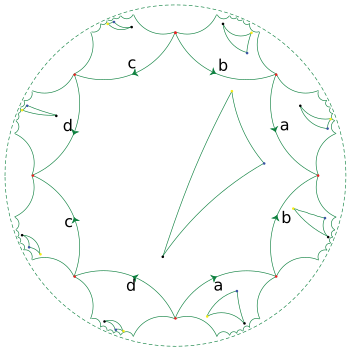
Fundamental domains illustrate how symmetry organizes space. They connect:
- Geometry: tilings, tessellations, and CMC surfaces.

- Topology: quotient spaces and surface classification.

- Complex analysis: Riemann surfaces, modular forms, and analytic continuation.

From lattices and strips to Möbius transformations, fundamental domains provide a single window into infinite, symmetric structures. They allow us to reduce global complexity to a local study, a principle that echoes throughout mathematics.
Leave a Reply